20200329

FTL: Faster Than Light

Developer: Subset Games
Publisher: Subset Games
Release: 2012
Platform: PC (played), iOS
Genre: Roguelike

It took me some time to realize The Kestrel (the very first ship available in the game) could only get me so far. After dabbling with a cautious approach (and most of the times becoming a dry floating coffin, waiting for the wave of enemies to find and finish us), an aggressive approach (only to be rewarded less often and less profusely than desired for the aggressive stance to pay off) and a case-by-case mix of both (eventually getting sucked down in an uncontrollable spiral of bad events after the inevitable unlucky strike) I decided to step back and check the game’s options before jumping straight into it. Only then I got to the screen that displays the list of ships the game would be playable with, and only then it hit me that The Kestrel was only the first of eight in a linear tree of unlockable (under particular circumstances) vessels.

Acknowledging that I didn’t even start to scratch the game’s surface and armed with (besides the experience of failing in several ways--“dying is funny”, one of the in-game random hot tips say) the knowledge that a new ship would be unlocked if I could at least reach level 5 I went for a confident “coward” run: sneak through the less-dangerous path towards the next less-dangerous sector, focusing on surviving enough to escape, escaping enough to repair at stores and that was it. Of course, as with everything in the game playing against the odds is the norm; so once I got a favorable chain of green (the theoretically more friendly) sectors I managed to open that can--alongside one of those 1.8% achievements, “I don’t need no stinkin’ upgrades!”, for reaching level 5 without any of them.


Another whole round of defeats ensued aboard The Torus (the Engi Cruiser), but many more things were learned in the process: the advantages of Ion devices (and lighter/faster weapons) and the reliability of drones were among them, but the most important one by far was becoming more aware of the biological/political environment around me. Being a human in the game (“common and uninteresting” according to the game’s lore) bears much resemblance to being one in real life: ditching anthropocentrism (or even more mundane selfishness for that matter) requires work and it’s not simply there by design.

So I started to actively seek a more diverse crew to learn about and play to their strengths/weaknesses. Using Engi as remote hackers (besides their everyday knack for fixing local wares) proved an invaluable way of avoiding blowing stuff up, for instance. I also learned to love the Zoltan for their natural energy flow--even making up for a power source within the room they’re deployed to in case of a lack of a proper resource to get the job done. The slow but impervious-to-fire Rockmen could be useful when fighting flames within the ship, for instance. But one of my gameplay sessions unexpectedly morphed into a proper piece of plot through a Mantis addition to my crew.

I’ve got the insect-like soldier as a tribute from a slave seller (I happened to shoot such ships down before, but that kills everyone in the ship--slaves included--so I figured I should try saving at least one living being this time) and (coincidentally or not) ran into a Zoltan peaceful ship right after. The Zoltan captain started a philosophical chat about being part of the Federation or being a rebel, and I went down that path alongside him. By the end of the exchange they offered me an augmentation (a kind of item that works as a passive buffer regardless of the ship’s available resources) called the Zoltan Shield--an “impenetrable shield” created by “an unexplained technology”--that was a game changer, allowing me to survive enough to repair the hull of my ship and advance further towards the next sector--which happened to be controlled by the (hostile) Mantis.

Still recovering from the unexpected “enlightenment” encounter, I ran into a ship described as having “dozens of layers of armor-plating added over what must have been a hundred year career” and led by the legendary thief KazaaakplethKilik. My crew freaks out, and everything derails badly after a clumsy attempt of contact by my Mantis soldier. I promptly decide to run, but even to do so we have to buy time for the FTL (“Faster Than Light”, which lends the game its name) module to charge before doing so; and trying to pull it off we started using our Ion equipment to slowly paralyze the enemy ship--without ever having a fight in mind, let alone a victory. The thing is, we get some early lucky strikes on, our miraculous Zoltan Shield holds up pretty well and our drones start making significant damage. By the time the FTL was charged we were more inclined to win the battle than to lose, so… we press on. And, absurdly, their ship starts to crumble before us. The game mumbles something about “a mystery” after his demise and I’m still incredulous about what just happened. I can’t even tell if it was the “right” thing to do or not, erasing such a huge part of the system’s history without having any previous knowledge of it or ever wanting to do so.

As we head into the next level, everything in pretty bad shape after the singular event, we’re massacred by a regular pirate ship. I know we can do nothing about it, so I simply watch the crew desperately trying to put the spreading fire down until we finally explode in slow fashion… with a lasting sense of having accomplished something.

(Disclaimer: this is the first time I write a post as a piece of chronicle in this blog; and also the first game I write something about without beating it first.)


20190617

Radiant Historia

Developer: Atlus, Headlock
Publisher: Atlus
Release: 2010
Platform: Nintendo DS (played), 3DS
Genre: RPG

Time travel-based narratives are prone to plot holes, deal-breaking twists and inherent inconsistency problems, and Radiant Historia is no exception to that; but the game falls short from being stellar not on behalf of those.

Ambitious as it is for a portable exclusive release, the game is rough around the edges--and it shows. Sometimes it’s just about minor cosmetic details, like the lack of diagonal sprites/animations; other times more important issues surface, as the unreliable hit detection--or worse, when bad stats balancing (like poisoning damage hurting more than a full direct hit, or weaknesses being rendered irrelevant too frequently) almost break the innovative positioning/combo battle system.
Portraits/character design are gorgeous overall
But if a JRPG--especially one with a time gimmick at its core--is at least 50% story, players who come for that will be neatly served. The characters are strong and believable (and gorgeously presented while at it), the heavy focus on politics is well explored and creates a timeless relatable setting and the plot is interesting enough to make up for the false “choose your path” pitch (both main and alternative timelines will have to be explored eventually, like it or not). And even if the game isn’t Chrono Trigger-tier the heavenly Yoko Shimomura’s score makes it feel almost so.

Not without its shortcomings, Radiant Historia is still well worth the ride for focusing on what matters most as a trusty representative of the tradition it’s part of.

20190514

EDGE

Developer: Mobigame
Publisher: Mobigame
Release: 2008
Platform: Android, iOS, PSP, PC (played), Mac, Wii U, 3DS
Genre: Puzzle

Yet another geometric-shaped puzzler, EDGE elevates itself above the rest through sporting finesse in almost every aspect of the production process. Art direction, graphics (tech and art wise), sound (both music and sound effects) and level design are all pristine, and the final product is well balanced between retro-ey and modern.

When it comes to gameplay mechanics things get a bit more complicated--even though that was a conscious design decision as well: the innate "digital" (meaning stiff) character of the main avatar gets in the way of the "analogue" (meaning subtle) needs of many of the most interesting puzzles. That's because "rolling" a cube down tight platforming conundrums or quick shape-shifting environments can only feel awkward and lead to death-by-trial-and-error since quickly reacting out of danger is out of question. In the times the game acknowledges that as a feature and puts it to good use, it clicks brilliantly; but maybe there is near the same amount of frustration around.

"Parkouring" with a cube can be both frustrating and delightful
As a piece of videogame art the outcome is highly positive though. Even if EDGE has its flaws it's good to see this degree of confidence shine through the entire journey of a game in such a cohesive fashion.

 Play Asia

20190228

Marvel Puzzle Quest

Developer: Demiurge Studios
Publisher: D3 Go!
Release: 2013
Platform: Android (played), iOS, PC, X360, PS3
Genre: Puzzle


Aeons after the "licensed IP golden era" (back when having Disney slapped in a videogame box meant more than Nintendo Seal of Quality by miles) Demiurge managed not only to make a decently balanced F2P match-3 game but also (even rarer) to play in favor of the original material's values.

Mechanics wise the gameplay is pretty straight-forward: matching gems damage enemies while charging special powers within the same spectrum; teams can be assembled to concentrate efforts in a given playstyle or to cover one another's weaknesses.

But battle for what? Ultimately for growing a collection of heroes, which vary from one to five stars accordingly to their rarity--and here the good IP use starts to show. Tokens aren't just digital keys; they're represented by real life comics' covers, both holding the possibility of being a personal meaningful memento for any given player and allowing the devs to explore several iterations of a character without having to stick to a single "definitive" (and inherently controversial) version.


Patch Wolvie: best there is? You're well served.
But there's more. The juggling an Avengers movie scriptwriter must go through to make every single character meaninful is amplified here in sheer numbers and scope alike--from godlike, almighty characters like Thanos to literally Howard the Duck (and everything between) each and every piece of IP has a chance to shine through some fine-tuned balance job. Obvious stuff are in play, of course (charging red gems for Iron Man's Unibeam, for instance), but many interesting mechanics are pulled from passive powers, starting with Hulk's "Anger" (creating green tiles when hit above a certain threshold) and developing towards more complex (and well-informed) behaviours like Carnage's unruliness serving trouble to friend and foes indiscriminately.

F2P is devilish though, and the usual "behind the curve" feel for a non-paying player is here, light as it is; but even that it's not enough to break the carefully handled Marvel spell.


 Yamatoku Classic Retro Games

20190121

Super Mario 3D Land

Developer: Nintendo EAD
Publisher: Nintendo
Release: 2011
Platform: 3DS
Genre: Platformer


Being given birth some fitting 9 months into the hardware’s maturing life Super Mario 3D Land is the first non-gimmicky title to make the 3D slider truly useful—if not almost mandatory in a couple dizzying sections.

But having the best 3D in the platform comes at a cost—and at times a high one: a heavily scripted, stiff camera system. Compelling as they are, the beautifully crafted levels are meant to be experienced in specific ways; that is less harming when it’s just about the game showing off, but it steadily grows in annoyance in tighter platforming sections, leap-of-faith star coins or the battles where Bowser looks awesome at expense of the very ground the player needs to thread.


Gorgeous, but not very functional.
Another structure issue keeps that very same top-notch design from being fully enjoyable: ol’ time limits are just pointless where the series is now—to the point there are extra clocks clumsily scattered around with the sole purpose of making exploration affordable.

Despite never quite unlocking its full potential Super Mario 3D Land remains a fine example on Nintendo’s ethos of making good hardware-informed software.

 eBay


20180917

Braid

Developer: Number None
Publisher: Number None, Microsoft Game Studios
Release: 2008
Platform: X360, PC (played), PS3
Genre: Puzzle

Video games as an art form were already proven back in 1985 with the physics + levels design of Super Mario Bros. working together flawlessly (and arguably even before in any risk/reward arcade tweaked to perfection), so it’s curious—and a stark commentary on the medium’s audience—that the issue could only be officially brought to table through some blatant “artsy” releases in the late 2000s. That’s exactly the case with Braid—and it’s probably the most impactful game from that crop too.

As a puzzle-platformer it’s just mediocre: puzzles are often single-minded and obtuse, while mechanics doesn’t communicate well; on the platforming side its physics are too wobbly/bouncy to be reliable—given that they can help conveying the dreamy atmosphere in the player’s hand at a cost.

Some puzzles can have terribly specific solutions.
As a storytelling catalyst, it’s heavy-handed—as if the abstract gameplay needed the help of some overly detailed depiction of a vague plot (even if disguised in some “poetic” fashion of sorts) to float. (The fact that the ending is tied to a mandatory 100% completion run weights on that too.) But in any art medium (games included) information in excess can hinder the user’s relatability, and that disbalance between gameplay and plot shows.

But everyday judgement aside, perhaps the core of the experience is really the best it has to offer: the time-rewind mechanic, gimmicky as it is, is what really subverts the medium’s long-lasting basic values, with or without plot excuses. The lack of strict “lives” or “tries”, or even further, the downright “inability” to die, speaks louder than any essay on the matter could to propose other ways of approaching “challenge”, “difficulty”, “rhythm” and many more subjects within game design’s craftsmanship; and Braid’s value lies precisely here.

20180821

Endless Ocean


Developer: Arika
Publisher: Nintendo
Release: 2007
Platform: Wii
Genre: Sim

If observing a traffic jam makes mankind pale in comparison to a highly organized school of shiny fish, Endless Ocean may have stayed too true to that. Every earthly aspect of the game ranges from lackluster to downright cringeworthy: people’s 3D models are ugly, walking cycles are terribly stiff, jetski cutscenes are shameful... Even the human half of the soundtrack (“voiced” by Hayley Westenra) falls short against Ayako Saso’s magnificent instrumental background music.

But here’s the thing: if gamedev resources are known for being finite, it’s also good to see Arika putting their money where the heart is. As soon as the player drops below water line the state of things change dramatically.

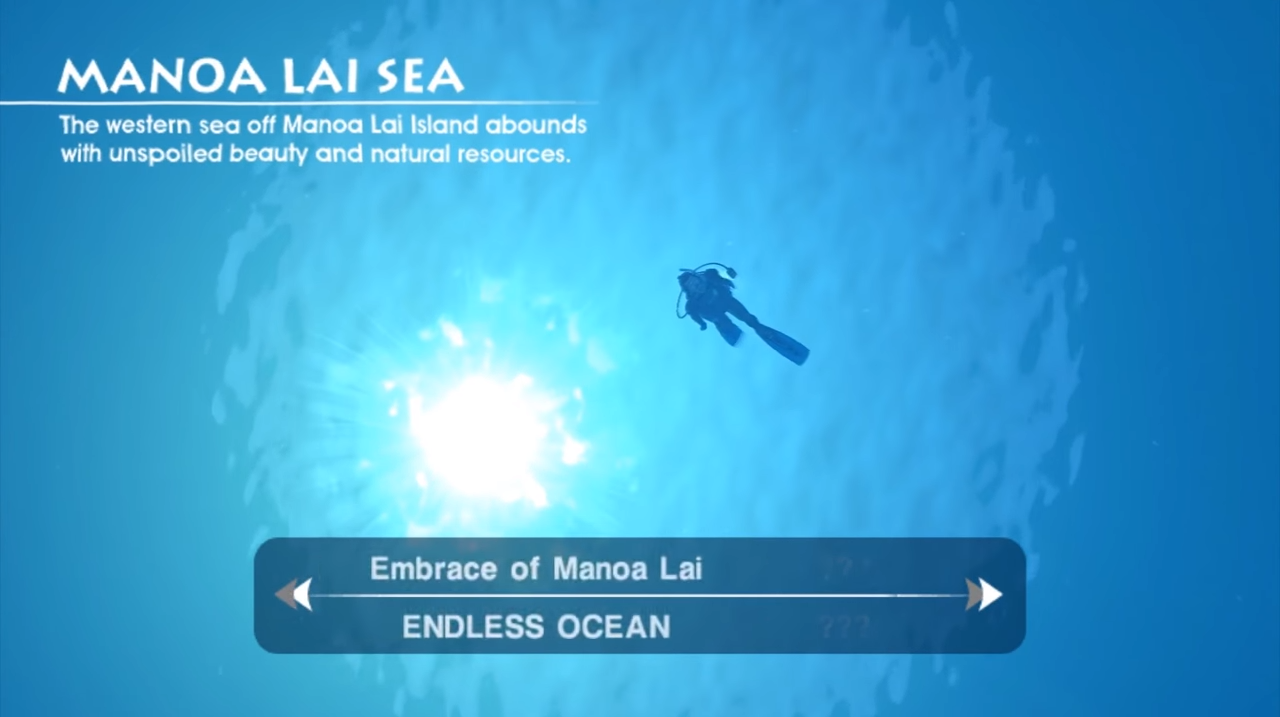
It’s surprising to see how good-looking the game is despite running within Wii’s infamous last-gen hardware restrictions, and that's only possible due to some smart texture tricks applied to both animals and environments (the later can feel empty and bland at times but are still organic enough to hold the stage together well enough). Also, motion controls here (specially using the pointer to play single-handed) work as a charm to elevate gameplay’s immersion (no pun intended) and help to fully realize Arika’s vision for the series (named Everblue in the first two PS2-exclusive entries).

It looks much better from below.
Tech stuff aside, Endless Ocean truly shines when it comes to meeting sea life on the spot. From small clownfish to dolphins and beyond (even stretching the reality a bit to make it fit a small fictitious sea) every life form is beautiful and believable--to the point of making some special encounters really unforgettable. And such being the case, it’s not hard to pour dozens of hours into the game while looking for different critters throughout several locations and the seasons of the year.

Add to some “bestiary completionism” the fact that items can be salvaged from the sea bottom--while watching a beautiful map shed as its secrets are uncovered--and there's the perfect collectathon for those not in a rush.